Some rooms are meant for quiet. Not the quiet of an empty space, but the particular stillness that gathers in a corner where books and candlelight and the smell of dried herbs have slowly built something that belongs only to you.
A dark cottagecore reading nook is that kind of space.
The dark cottagecore aesthetic sits at the intersection of several overlapping visual and lifestyle movements. It draws from traditional cottagecore, with its love of slow living, natural materials, and handmade detail, but shifts the palette and the mood toward something older and more shadowed.
Where cottagecore reaches for daisy chains and open windows, dark cottagecore reaches for dried botanicals, apothecary glass, candlelight, and the kind of nature that keeps its secrets. It overlaps with witchcore, dark academia, and goblincore, pulling something from each without being entirely defined by any of them.
The reading nook is one of the most natural expressions of this aesthetic because the values are already built into the form. A reading nook is inherently slow. It is a dedicated space for a single unhurried activity, designed to be apart from the rest of the room and the rest of the day. Add the dark cottagecore layer and it becomes something more intentional still: a space rooted in curiosity, in the natural world, in old knowledge and the pleasure of sitting with it.
The Ultimate Dark Cottagecore Colour Palette Collection
Explore a growing library of dark cottagecore colour palettes pulled from poison gardens, candlelit kitchens, foggy forests, and shadowed interiors. Hex codes, RGB values, and home decor ideas for every shade. New palettes added regularly.
RELATED:
Unlike a full room redesign, a dark cottagecore reading nook can be built gradually and inexpensively. A corner, a chair, a bookshelf, and a few well-chosen objects are enough to begin.
The details accumulate over time, which is exactly how the aesthetic is supposed to work. Nothing here should look like it arrived all at once.
This post walks through every element you need, starting with the bookshelf at the heart of the nook and working outward into lighting, seating, botanical detail, and the finishing touches that make a corner feel genuinely lived in.
Start With the Right Corner
The best reading nooks are tucked.
A recessed alcove, the space beside a chimney breast, a narrow wall framed by two windows. If none of those exist in your home, you can create the feeling of enclosure with a tall bookshelf on one side, a heavy curtain on the other, and a rug that draws a clear boundary between this space and the rest of the room.
What you are after is containment. A dark cottagecore reading nook should feel like stepping slightly out of ordinary time.

Build the Dark Cottagecore Bookshelf First
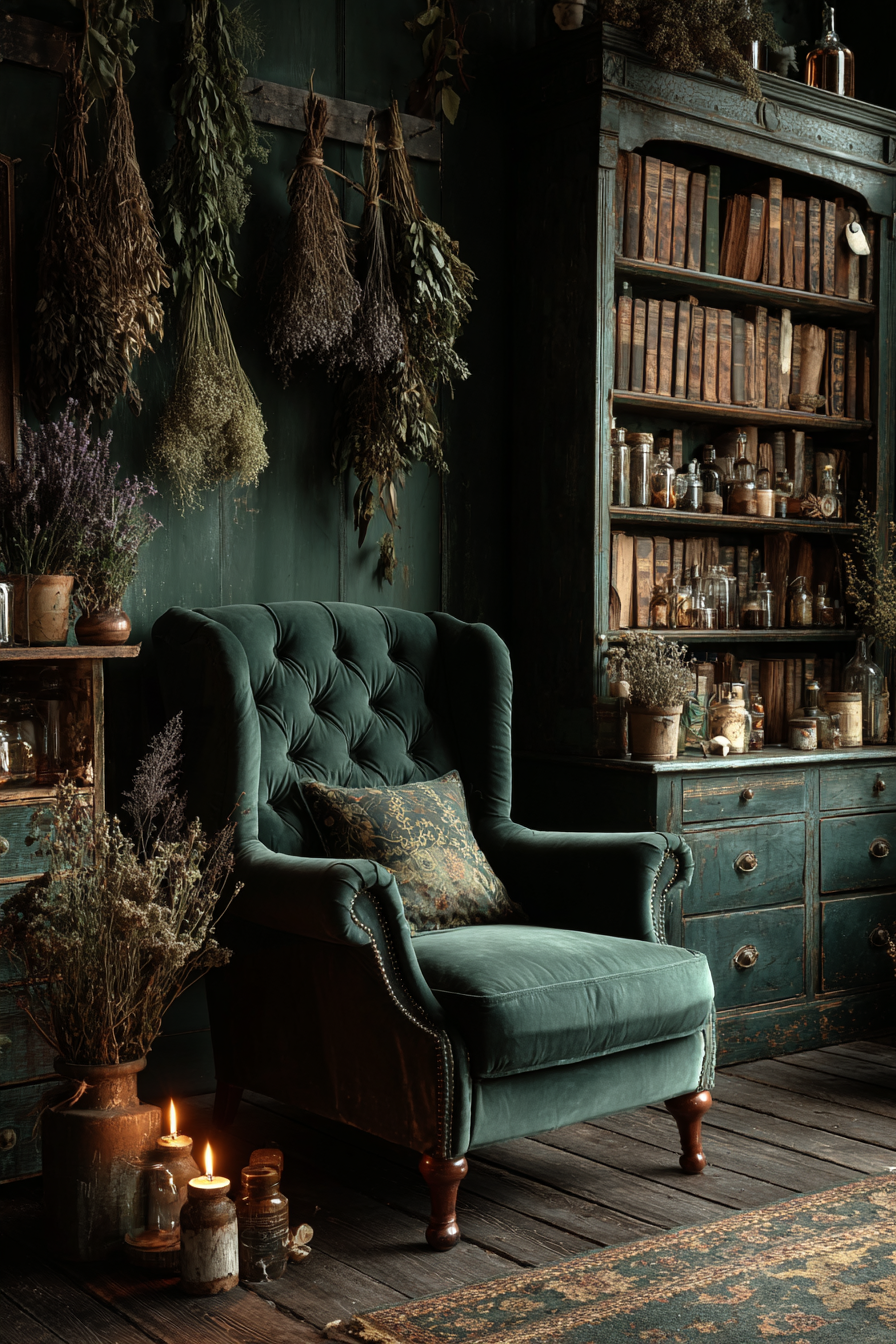
The bookshelf is the backbone of the whole nook. Everything else orbits it. For a dark cottagecore reading nook, the bookshelf is not just storage. It is a cabinet of curiosities, a specimen collection, a window into whoever tends this corner.
Choose dark or natural wood. Walnut, aged oak, and painted black shelving all work well. Avoid anything too modern or flat-pack in finish. The goal is something that looks as if it has been in the room for decades.
When it comes to arranging the shelves, resist the impulse to organise by colour alone. Instead, mix books with objects. A small apothecary bottle beside a cluster of spines. A pressed botanical specimen leaning against a stack of hardcovers. A single taper candle in a tarnished brass holder tucked at the end of a row. A dried bundle of lavender or mugwort laid flat across a lower shelf.
The dark cottagecore bookshelf earns its character from these layered details, not from a single styled moment.
Layer the Lighting
Overhead lighting will ruin a reading nook. Turn it off entirely if you can. The dark cottagecore reading nook runs on layered low light: a small table lamp with a warm amber bulb, one or two taper candles in holders that have clearly seen better days, and perhaps a string of very dim fairy lights tucked along the inside of a shelf.
The goal is pools of light rather than even illumination. You want some of the room to remain in shadow. That contrast is what gives the space its atmosphere and its sense of remove from the rest of the world.
Battery-powered LED candles are a practical compromise if open flames are not possible. Look for ones with a warm flicker setting rather than a steady glow.
RELATED:
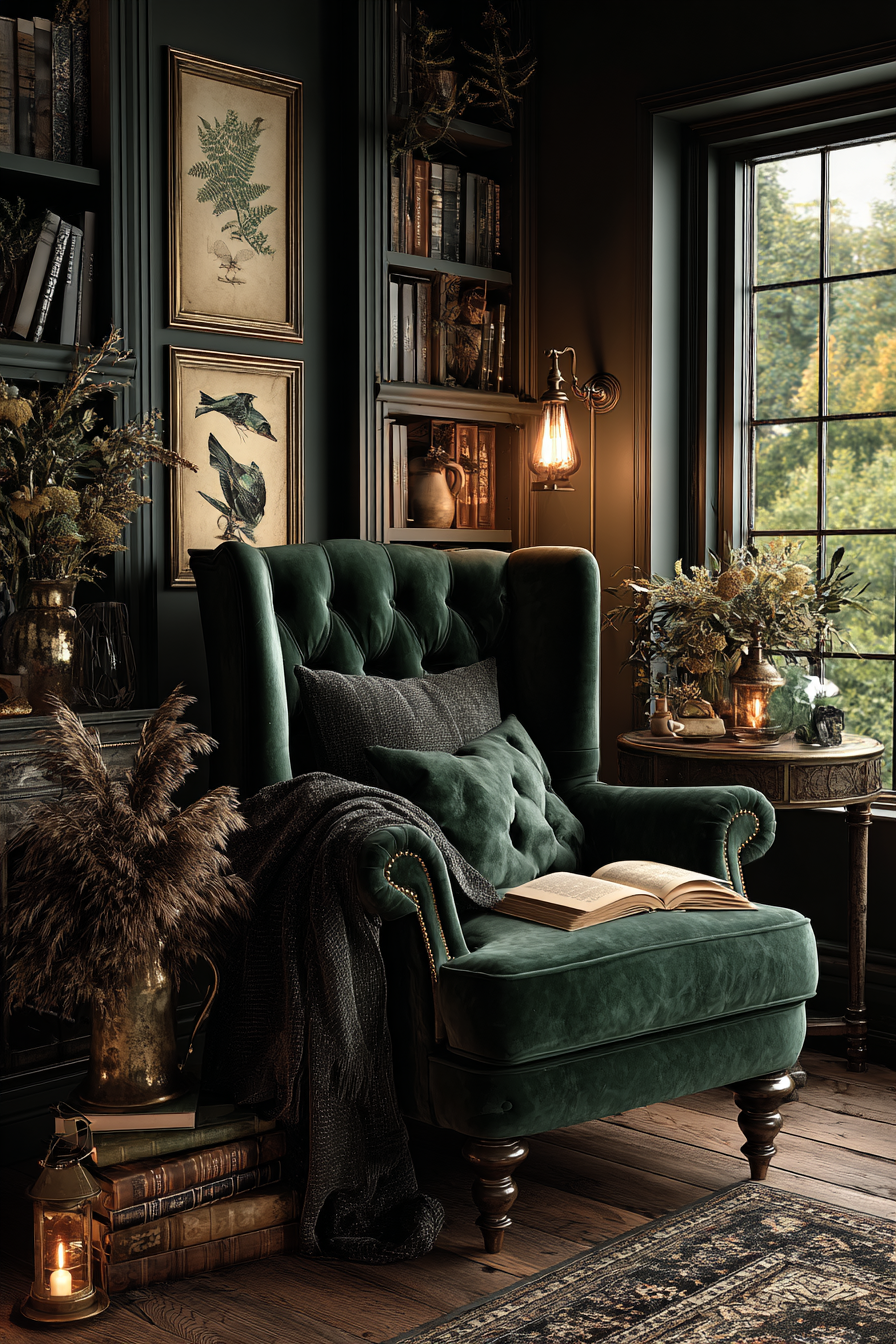
Choose Seating That Encourages You to Stay
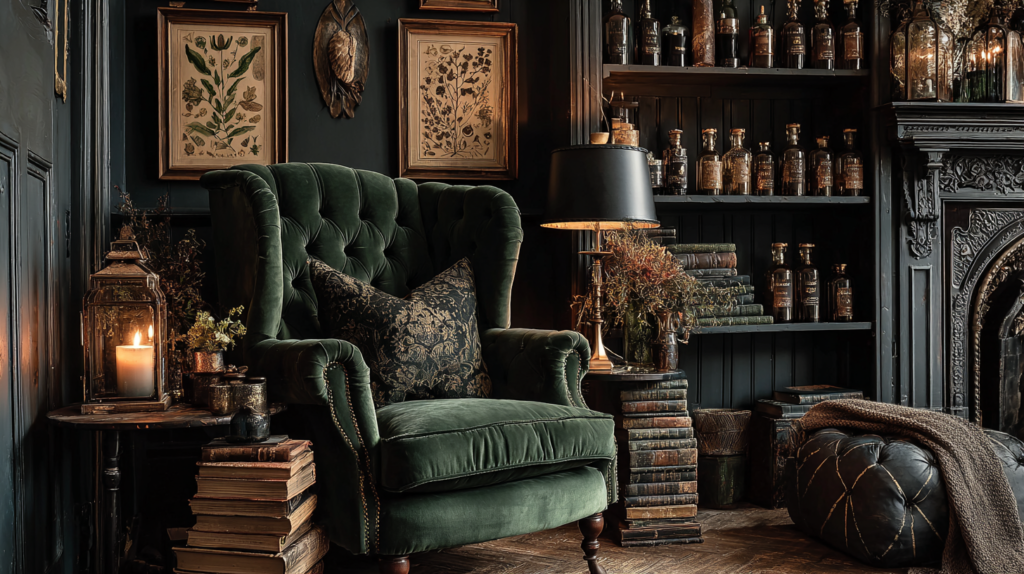
A dark cottagecore reading nook needs a chair that takes commitment to leave. Deep velvet armchairs in forest green, charcoal, or midnight blue are the obvious choice, and the obvious choice is correct here.
Add a wool or faux fur throw in a muted earth tone across the arm or back. A small footstool makes the whole arrangement feel more settled.
If the nook is floor-level, a large floor cushion or a pile of oversized pillows on a layered rug can work just as well. The softness matters more than the specific piece of furniture.
Bring in Botanical and Witchy Details
This is where the dark cottagecore reading nook separates itself from a simply moody or minimal space.
The botanical details are what make it feel like it belongs to someone specific, someone who knows the difference between foxglove and hemlock and thinks that knowledge is worth having.
A few ideas to work with:
- A small framed pressed plant specimen on the wall directly beside the bookshelf.
- A cluster of dark dried florals in a ceramic or dark glass vase on a side table.
- A single candle scented with something grounded and herbal rather than sweet.
- A worn leather journal and a dip pen left on the side table as if mid-use.
- An antique or vintage magnifying glass.
- A small dish of acorns, dried seed pods, or smooth stones gathered from somewhere that mattered.
None of these elements need to be expensive. The best ones rarely are. What they need to be is specific and intentional.
Keep It Imperfect
The temptation when designing any nook is to style it until it no longer looks like it belongs to a real person. Resist this.
The dark cottagecore reading nook is not a showroom. It is a space that should look as if someone left it only moments ago to put the kettle on.
Leave a book open and face-down. Let the candle wax drip a little before you wipe it. Allow a plant to grow slightly past where it is elegant. Let the throw be rumpled.
These are not flaws. They are the evidence that the space is actually being used, and that is what makes it feel like somewhere worth staying.