There is a plant that has been poisoning people, healing people, and bewitching people for over a thousand years.
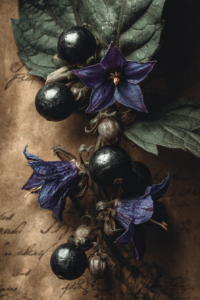
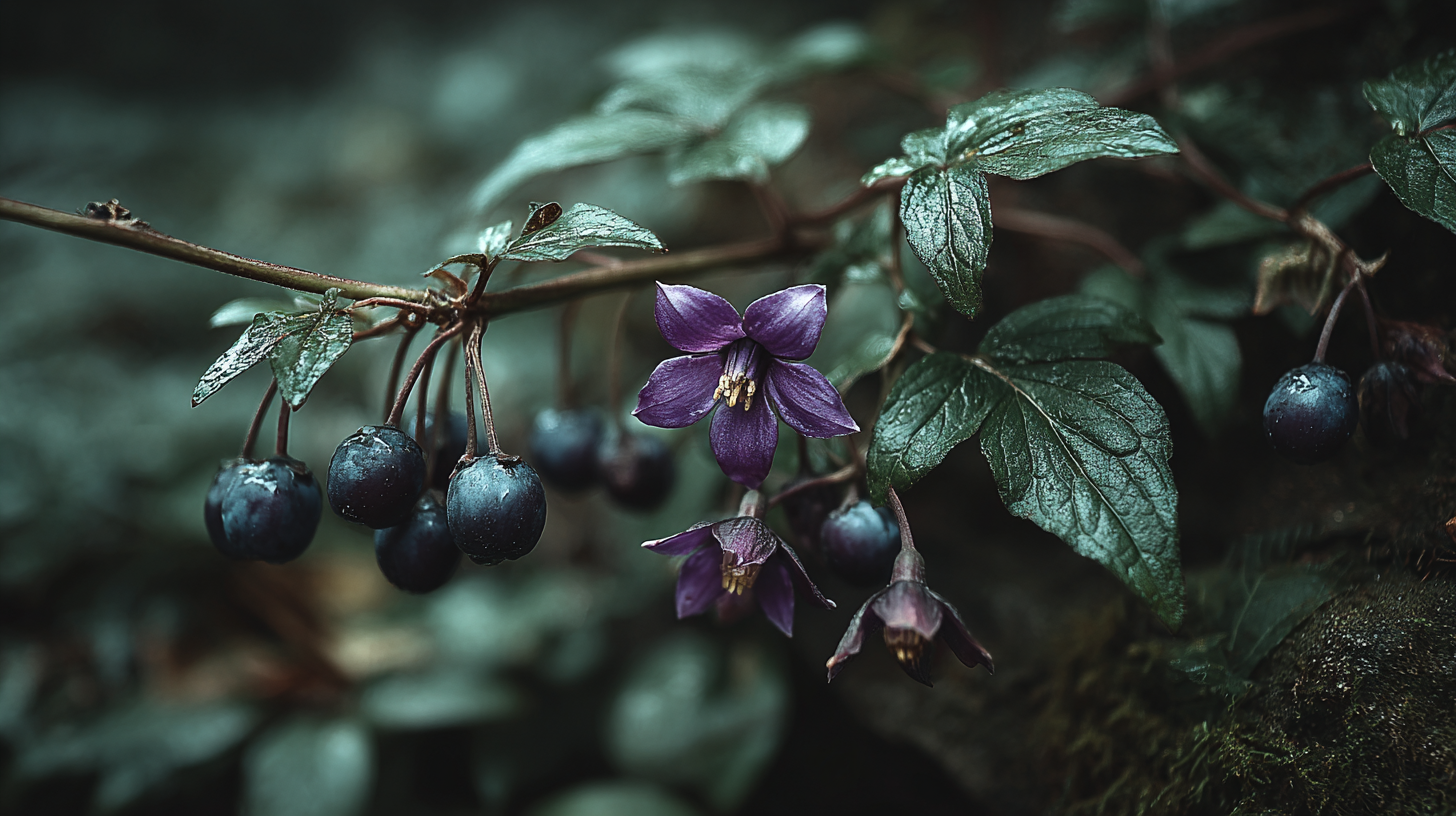
It grows in hedgerows and abandoned places. Its berries are glossy and black and taste, reportedly, sweetly of nothing in particular. Its flowers are small and purple and unremarkable. It does not announce itself. It does not need to.
Atropa belladonna, deadly nightshade, is the most storied plant in the poison garden tradition. It is the plant the brand is named after. It is the plant that appears in more witch trials, more royal poisonings, more Renaissance beauty rituals, and more medieval herbalism texts than perhaps any other.
If the poison garden has a queen, she has been here all along.
At Glance
- Scientific name: Atropa belladonna
- Common names: Deadly nightshade, belladonna, devil’s cherries, dwale
- Family: Solanaceae (nightshade family)
- Native range: Europe, North Africa, Western Asia
- Toxic parts: All parts – root, stem, leaf, flower, and berry
- Primary toxins: Atropine, scopolamine, hyoscyamine
- Toxicity level: Extremely high
What It Looks Like
Atropa belladonna is a perennial plant that grows up to 1.5 metres tall, with large, soft, dull green leaves that have an unpleasant smell when crushed.
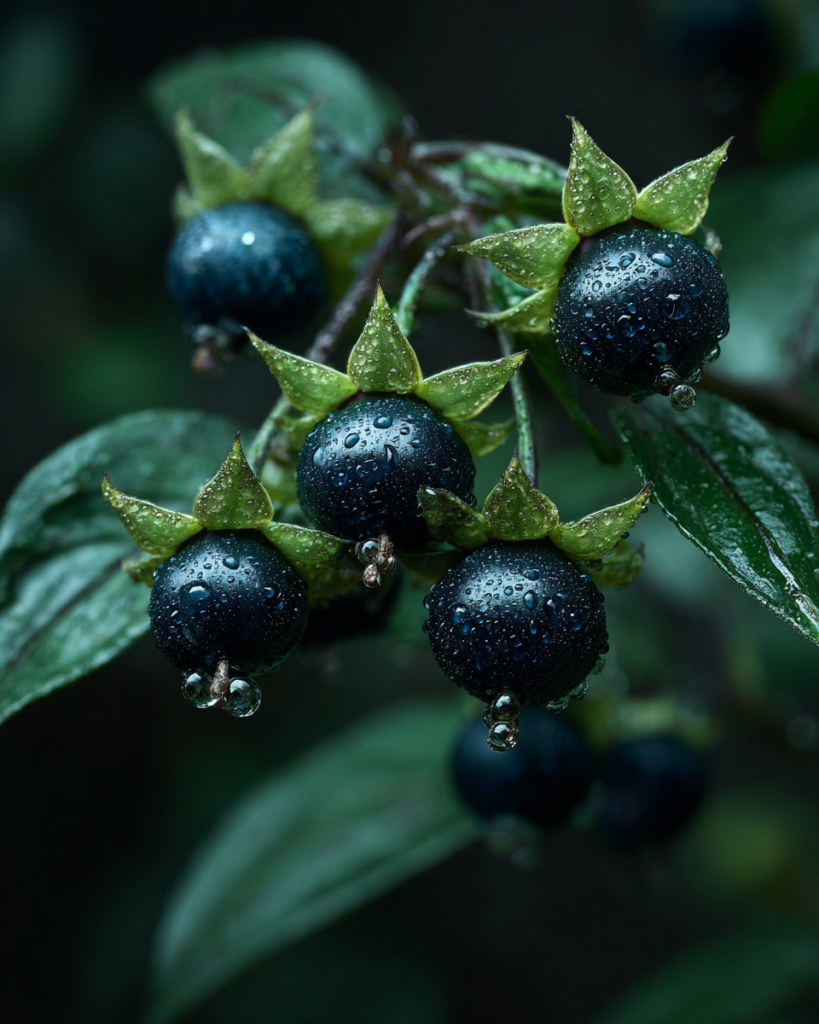
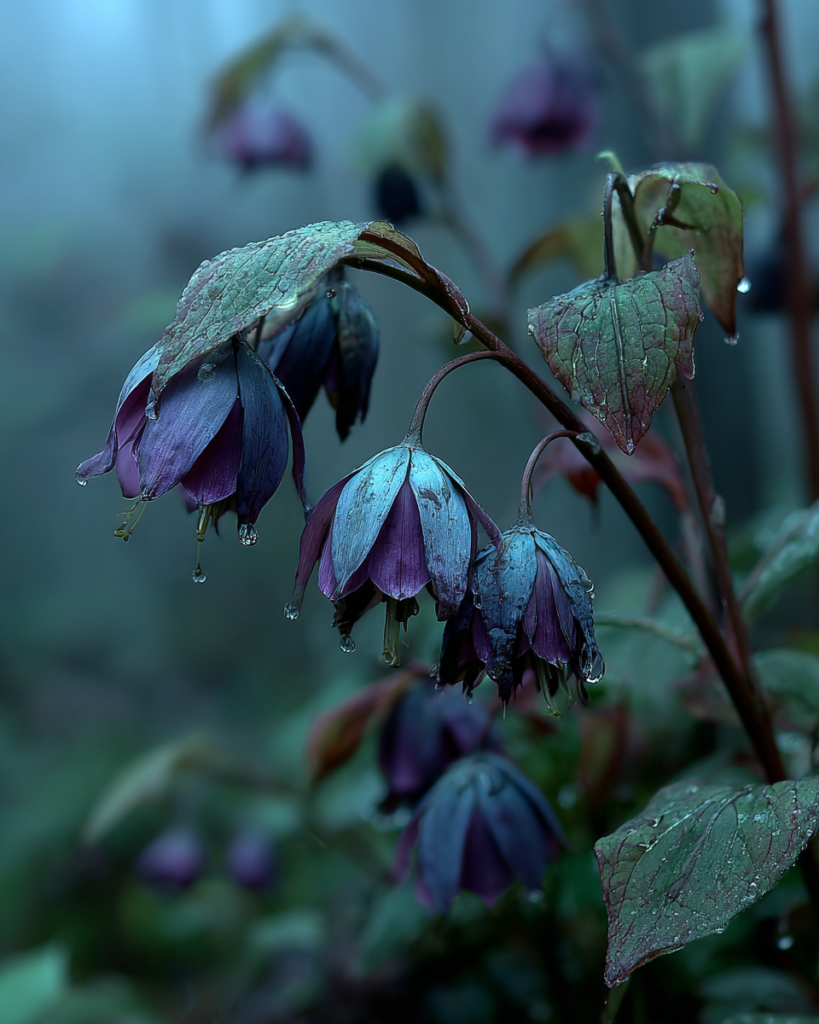
The flowers are bell-shaped, drooping, and dull purple–brown in colour – quiet and easy to overlook. The berries that follow are where the plant becomes visually arresting: shining, black, and plump, they sit in a star-shaped green calyx that frames them like a setting holds a stone.
This is the plant at its most dangerous. The berries are the part most likely to cause accidental poisoning, particularly in children, because they look edible and are said to taste mildly sweet.
The sweetness is the trap. Every part of the plant – root, stem, leaf, flower, and fruit – contains the same alkaloids in varying concentrations.
The Poison: What It Does
Belladonna’s toxicity comes from a group of tropane alkaloids: atropine, scopolamine, and hyoscyamine.
These compounds work by blocking the neurotransmitter acetylcholine, which is responsible for a wide range of involuntary bodily functions.
The result is a cascade of effects that follow a grim and predictable sequence:
- Dry mouth and difficulty swallowing
- Dilated pupils and blurred vision
- Rapid heart rate
- Flushed, dry skin and fever
- Hallucinations and delirium
- Seizures and loss of consciousness
- Respiratory failure and death at sufficient doses
The plant is fast-acting. The berries are the most accessible part, and as few as two or three have been reported to cause serious poisoning in children.
In adults, a larger quantity is needed for lethal effect, but the hallucinatory phase that precedes it makes poisoning by belladonna a particularly disorienting and dangerous experience.
Atropine derived from belladonna is still used in modern medicine – in ophthalmology to dilate pupils for examination, in cardiac emergencies to treat dangerously slow heart rates, and as a pre-operative medication.
The same compound that kills at high doses has a precise and legitimate clinical use at low ones. This is the poison garden principle at its most exact.
History and Folklore
The name tells you almost everything. Atropa comes from Atropos, the eldest of the three Greek Fates – she who cannot be turned, she who cuts the thread of life.
Belladonna is Italian for beautiful woman, a reference to the practice among Renaissance Italian women of using diluted drops of the plant’s juice to dilate their pupils, which was considered attractive at the time.
The name carries both death and beauty in equal measure, and the plant has lived up to both for centuries.
Ancient and classical use. Belladonna appears in some of the oldest written records of poisonous plants. It was associated with the goddess Hecate in Greek tradition, the deity of crossroads, magic, and poisonous plants, and was used in her rituals to induce visions. Roman poisoners reportedly used it freely: the historian accounts of Locusta, professional poisoner to the imperial court of Nero, place belladonna in several of her preparations.
Medieval witchcraft. Belladonna is one of the plants most frequently named as an ingredient in the infamous witches’ flying ointment of medieval European folklore. The ointment, which herbalists and historians now understand to have been a real preparation causing vivid hallucinatory states when absorbed through the skin, is said to have contained belladonna alongside henbane, mandrake, and datura. Whether the sensation of flying was a hallucination produced by these alkaloids or a metaphor for the altered state they created, the association between belladonna and the witch tradition is ancient and deep.
The accused and the knowledgeable. Belladonna appears repeatedly in witch trial records, not because those accused were necessarily using it for harmful purposes, but because knowledge of its properties was itself considered suspicious. Women who grew it, used it medicinally, or were simply found near it were implicated. The plant became evidence of dangerous knowledge simply by existing in someone’s garden.
Shakespearean shadow. It is widely speculated that the poison used in Romeo and Juliet – the draught that sends Juliet into a death-like sleep – was based on belladonna or a related Solanaceae compound. Shakespeare was writing in an era when the properties of these plants were widely discussed, and the symptoms he describes map closely onto tropane alkaloid poisoning.
Modern medicine. Atropine, isolated from belladonna in 1831, remains on the World Health Organisation’s list of essential medicines. It is used in eye examinations, in the treatment of organophosphate poisoning, and in resuscitation protocols. The plant that has been killing people for millennia continues to save lives in precise, calibrated doses.
In the Poison Garden
Belladonna earns its place at the centre of the poison garden for reasons that go beyond toxicity. It is the plant that most completely embodies the poison garden’s central tension: extraordinary beauty, extraordinary danger, and a history so entangled with human experience that it is impossible to separate the plant from the people who feared and used and named it.
In the dark cottagecore context, belladonna carries particular resonance. It is the plant of the hedge witch and the herbalist, of the women who knew too much about what grew in the hedgerow and paid for that knowledge in ways that have nothing to do with botany.
It is also a plant of deep aesthetic power: the dark berries against the green calyx, the drooping purple bells, the large soft leaves in the shadowed places where it prefers to grow.
As a specimen print, in pressed form, or as a recurring motif in dark botanical illustration, belladonna is the plant that announces what kind of garden this is. Not a garden of comfort. A garden that knows what it is.
A Note on Safety
Atropa belladonna should never be ingested in any form. All parts of the plant are toxic, and there is no safe recreational or experimental dose. The berries are the most dangerous part due to their resemblance to edible fruit.
If you grow belladonna, it should be kept away from children and animals, and gloves should be worn when handling it, as the alkaloids can be absorbed through skin. If poisoning is suspected, seek emergency medical attention immediately.