There is a plant whose seeds contain a poison so potent that a quantity the size of a grain of salt can kill an adult. There is no antidote.
It has been used as a weapon, studied by governments, and named on the schedules of international chemical weapons conventions. It is also grown as an ornamental in gardens across the world, valued for its large and dramatic foliage, and the oil pressed from its seeds is a common ingredient in cosmetics, lubricants, and traditional medicine.
Ricinus communis contains ricin, one of the most toxic naturally occurring substances known to exist. It also produces castor oil, one of the most commercially ubiquitous plant products in the world.
These two facts describe the same plant, the same seed, and very nearly the same process: the difference between poison and product is a matter of heat applied at the right stage. The castor bean is the poison garden’s most extreme example of the principle that runs through every plant in the collection. The dose is not the only variable. So is the process.
RELATED POSTS:
At a Glance
- Scientific name: Ricinus communis
- Common names: Castor bean, castor oil plant, palma Christi
- Family: Euphorbiaceae: Native range, East Africa, likely Ethiopia; now cultivated and naturalized worldwide
- Toxic parts: Seeds (beans) — the primary source of ricin; leaves also toxic
- Primary toxins: Ricin, ricinine
- Toxicity level: Extremely high — ricin is among the most toxic naturally occurring substances known
What It Looks Like
Ricinus communis is a fast-growing plant that behaves as an annual in temperate climates and as a large shrub or small tree in tropical and subtropical regions, where it can reach six metres or more.
In a single temperate growing season it typically reaches one to three metres, producing an impressive architectural presence in the garden.
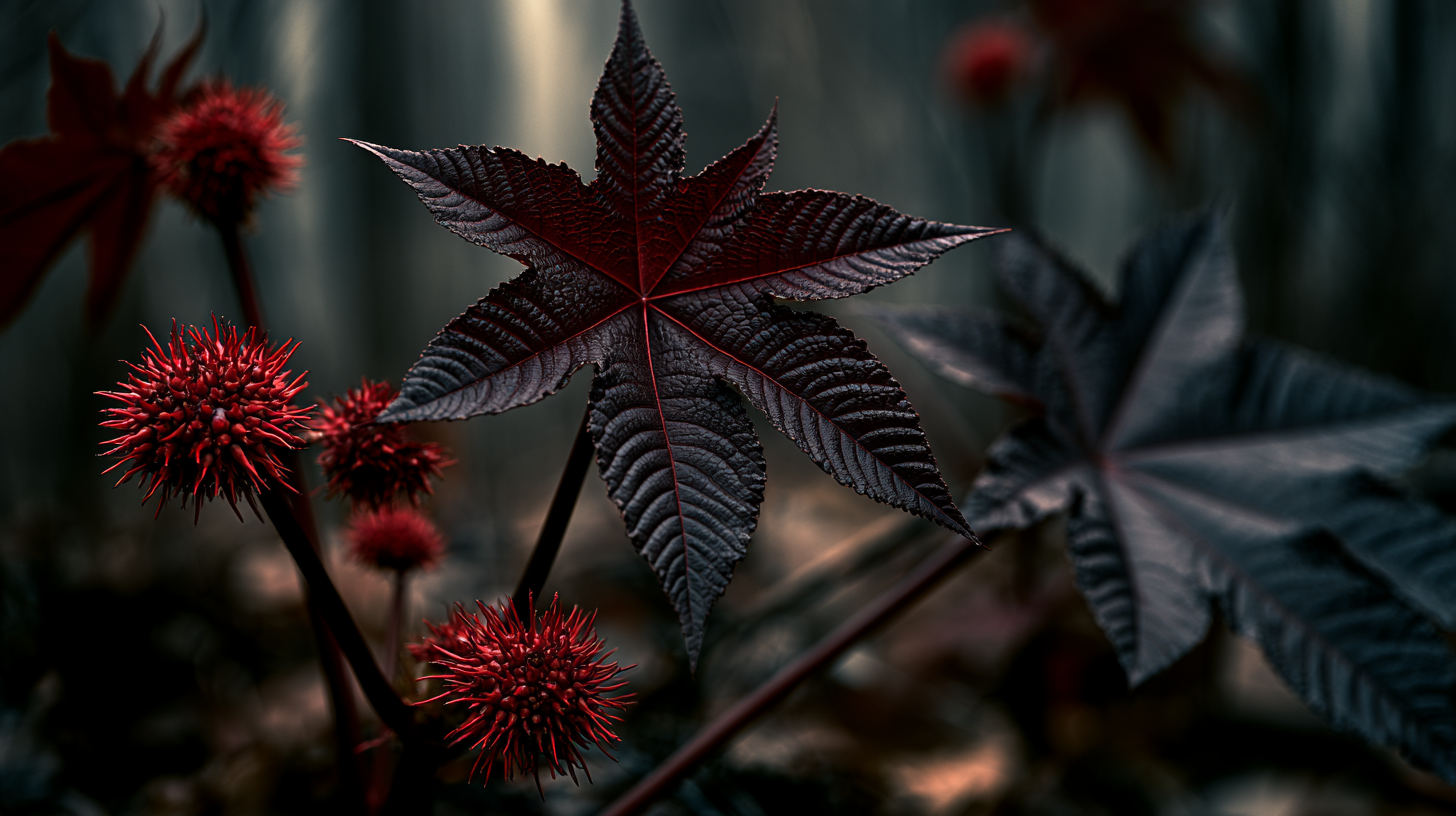
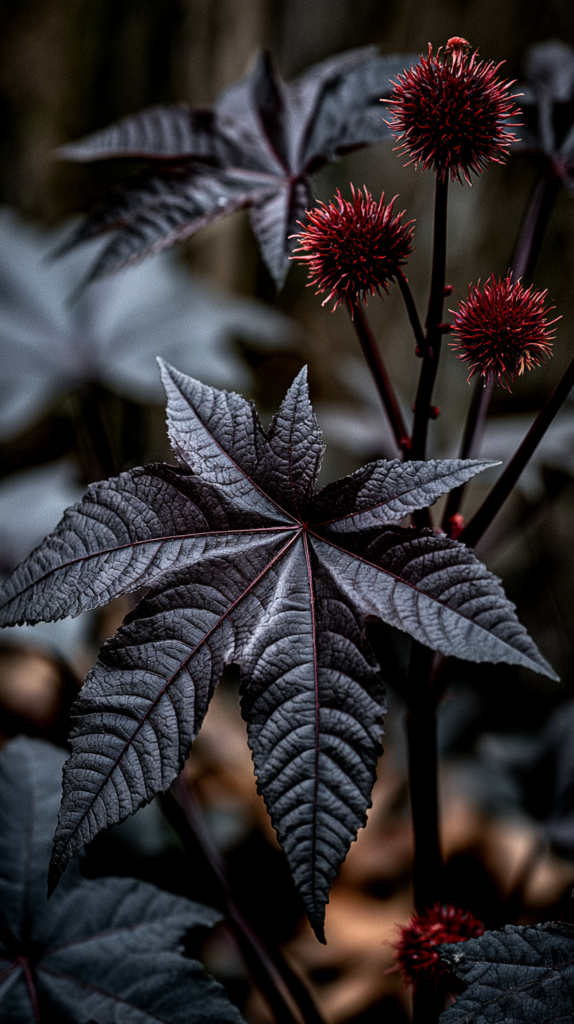
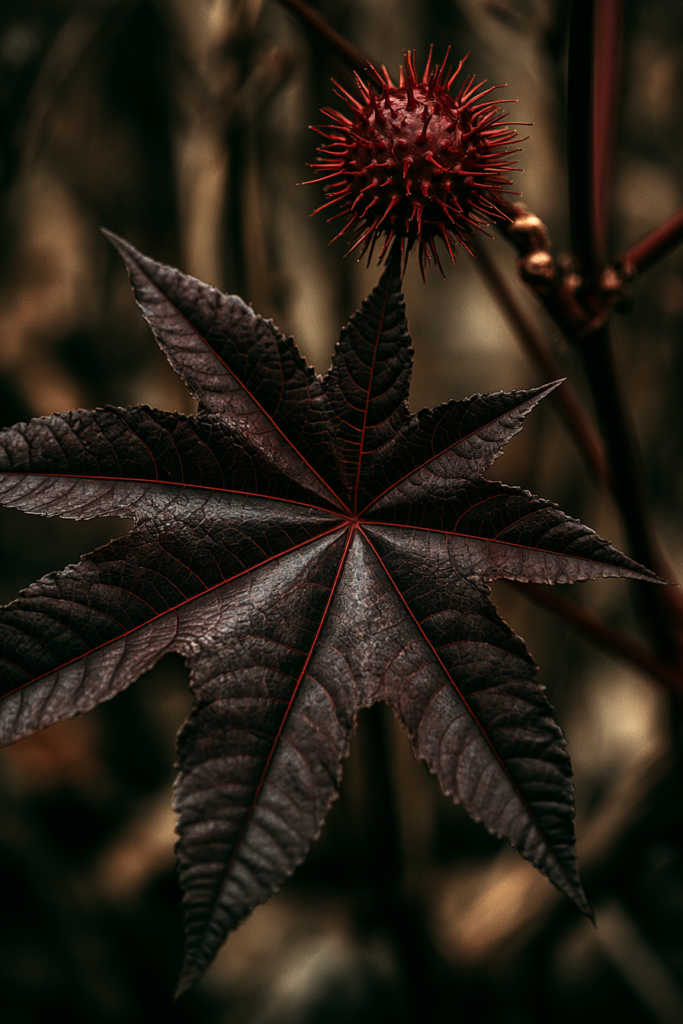
The leaves are the plant’s most distinctive feature: large, deeply lobed, and star-shaped, held on long stalks, in shades ranging from deep glossy green to burgundy, bronze, and near-black depending on the variety. Some cultivars, selected specifically for ornamental use, produce leaves of a very deep reddish-purple that rivals any plant in the dark garden for dramatic foliage colour.
The flowers are small and not especially ornamental: red or green spikes that develop into the seed capsules, which are covered in soft red or green spines and split open at maturity to release the seeds. The seeds themselves are smooth, mottled, and beautiful in a particular way: oval, with a marbled pattern of grey, brown, and cream that looks almost designed. They resemble a swollen tick, which has contributed to the plant’s Latin name, ricinus being the Latin word for tick.
The Poison: What It Does
Ricin is a ribosome-inactivating protein produced in the seeds of Ricinus communis. It works by entering cells and preventing them from synthesizing the proteins they need to survive. Without protein synthesis, cells die. Ricin affects cells throughout the body indiscriminately, which is why there is no specific antidote: there is no mechanism to reverse the damage once it begins.
The route of exposure affects the speed and nature of symptom progression, but all routes of serious exposure are potentially lethal:
Ingestion (chewing seeds releases ricin; swallowed whole seeds may pass through without releasing it):
- Nausea, vomiting, and severe abdominal pain within hours
- Bloody diarrhoea
- Dehydration and low blood pressure
- Organ failure, primarily affecting the liver, kidneys, and gastrointestinal tract
- Death within three to five days without aggressive supportive care
Injection or inhalation (the routes associated with weaponized ricin):
- Faster onset of systemic effects
- Rapid organ failure
- Death within 36 to 72 hours
What makes ricin so significant in the context of chemical and biological weapons is the combination of extreme potency, wide availability of the source material, and the absence of any antidote.
Ricin has appeared on the schedules of the Chemical Weapons Convention and has been the subject of state-level weapons research programs in multiple countries.
The distinction between ricin and castor oil is important and often misunderstood. Commercial castor oil is produced by pressing the seeds and then applying heat, a process that denatures the ricin protein and renders it inactive. The oil itself is not toxic. This is not a marginal safety distinction: castor oil is genuinely harmless in normal use. The poison and the product are chemically distinct, separated by a processing step that destroys one entirely.
History and Folklore
Ricinus communis has been cultivated for at least six thousand years, primarily for the oil pressed from its seeds. Its history as a useful plant is ancient and continuous. Its history as a poison is more recent in formal terms but has produced some of the most striking events in the modern history of political violence.
Ancient cultivation. Castor oil has been found in Egyptian tombs dating to around 4000 BCE. It was used as a lamp oil, a lubricant, a laxative, and a skin treatment in ancient Egypt, Greece, and Rome. Herodotus mentioned it. Dioscorides described both its medicinal uses and the danger of the seeds. The plant was valuable enough to be cultivated deliberately across the ancient Mediterranean and into Asia, which accounts for its wide naturalization across the tropics and subtropics today.
The Georgi Markov assassination. In 1978, the Bulgarian dissident and BBC journalist Georgi Markov was murdered in London using a modified umbrella that injected a ricin-filled pellet into his leg while he waited at a bus stop on Waterloo Bridge. He died three days later. The case was not solved during the Cold War and was not formally confirmed as a ricin assassination until forensic analysis of the pellet established the method. It remains the most famous use of ricin as a weapon against an individual and is one of the defining events in the history of political assassination by poison.
Weapons programs. During and after both World Wars, several governments including the United States and United Kingdom investigated ricin as a potential weapon. The US program, which produced a powdered ricin designated W, was discontinued but the research established the parameters of ricin’s lethality and aerosol behavior. The knowledge generated by these programs informed later inclusion of ricin in the Chemical Weapons Convention schedules, though ricin is technically classified as a biological toxin rather than a chemical weapon.
Contemporary incidents. Ricin has appeared in a number of contemporary terrorism-related cases, most commonly involving individuals who had processed seeds into powder with intent to cause harm. The relative accessibility of the source material, the castor bean plant being widely available as an ornamental, has made it a subject of ongoing concern for law enforcement agencies. None of these cases have produced mass casualties, which reflects both the difficulty of effective weaponization and the effectiveness of detection.
Folk medicine and palma Christi. The common name palma Christi, palm of Christ, reflects a long tradition of using castor oil medicinally in Christian Europe and in folk medicine traditions across Africa, Asia, and the Americas. It has been used as a purgative, a topical treatment for skin conditions, and in traditional midwifery practice. The name suggests a perceived healing quality that coexisted, in the plant’s cultural history, with full awareness of the seed’s toxicity.
In the Poison Garden
The castor bean occupies a unique position in the poison garden as the plant that most starkly illustrates the gap between appearance and reality that the collection exists to explore. It is grown as an ornamental across the world.
Its deep red and bronze foliage cultivars are sold in garden centres. It sits in borders and containers producing its dramatic star-shaped leaves while containing, in its seeds, one of the most toxic substances produced by any living organism.
Most people who grow it do not know this. Some who do know it grow it anyway, for the foliage, with the understanding that the seeds are the dangerous part and the plant itself is manageable with reasonable care. Both responses are comprehensible. The poison garden’s interest is in naming the thing clearly: this is what it is, this is what it contains, this is why that matters.
In the dark cottagecore context, the castor bean offers some of the most dramatic foliage available to the dark garden. The deep burgundy and near-black cultivars sit naturally in a planting scheme built around poison garden plants, dark textures, and the aesthetics of Victorian botanical illustration.
The seed pods, with their red spines, are striking enough to use in dried arrangements. The seeds themselves, with their mottled marbled pattern, have been used in jewellery and decorative objects across many cultures, a practice that carries its own risks and its own history.
As a botanical illustration subject, the lobed star-shaped leaf in deep red-bronze, combined with the spined seed capsule and the mottled seed, gives a rich set of elements for a specimen print. The plant is visually maximalist in a way that most poison garden specimens are not, and it rewards an approach that captures that quality.
A Note on Safety
The seeds of Ricinus communis contain ricin and should never be chewed or ingested.
Swallowed whole seeds may pass through the digestive system without releasing ricin, but this is not reliable and should not be tested.
The leaves are also toxic. Wear gloves when handling any part of the plant and wash hands thoroughly afterward. Keep children and animals away from the seed pods, as the seeds are attractive and could be mistaken for beans or ornamental objects.
If ricin poisoning is suspected, seek emergency medical attention immediately. There is no antidote; treatment is entirely supportive.