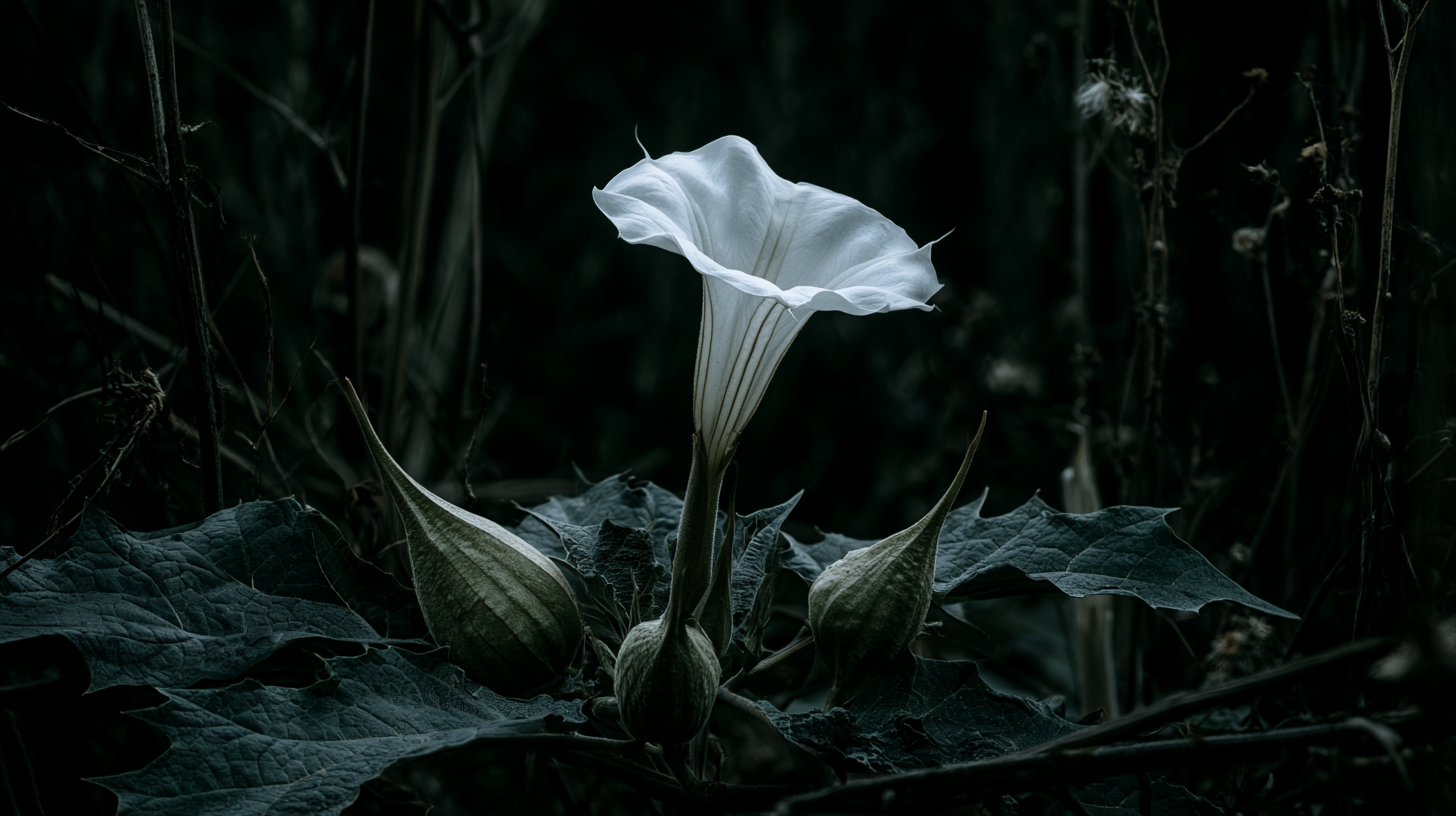
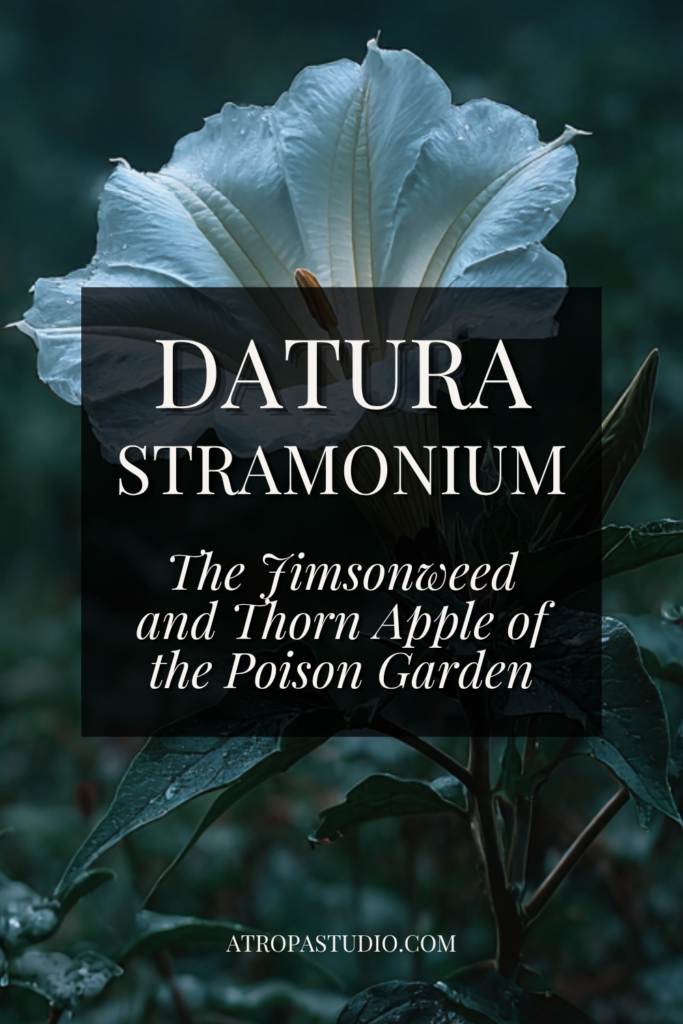
Datura stramonium produces some of the most striking flowers in the poison garden: large, white, trumpet-shaped blooms that open in the evening and release a heavy, sweet fragrance. It is also one of the most toxic plants commonly found growing wild across much of the world.
The plant has a long documented history of ceremonial and medicinal use across several cultures, and it also has a long documented history of causing serious poisonings and deaths. These two facts are not contradictory. Both come from the same underlying property: datura’s effects on the nervous system are powerful, and the gap between an active dose and a dangerous one is narrow and unpredictable. That combination is what has made the plant significant, in both directions, for a very long time.
RELATED: The Poison Garden Plant List: A Complete Guide to Toxic and Bewitching Botanicals
At a Glance
Scientific name: Datura stramonium
Common names: Jimsonweed, thorn apple, devil’s trumpet, devil’s snare, locoweed, stinkweed
Family: Solanaceae (nightshade family)
Native range: Disputed – likely Central America or the Caribbean; now naturalized worldwide
Toxic parts: All parts; seeds contain the highest concentration
Primary toxins: Atropine, scopolamine, hyoscyamine
Toxicity level: High, with significant unpredictability in dose
What It Looks Like
Datura stramonium is an annual plant that can grow up to 1.5 metres tall. Its leaves are large and coarsely toothed, with a strong, unpleasant smell when crushed.
The stems are thick and branching, giving the plant a fuller, coarser appearance than many of its more delicate nightshade relatives.
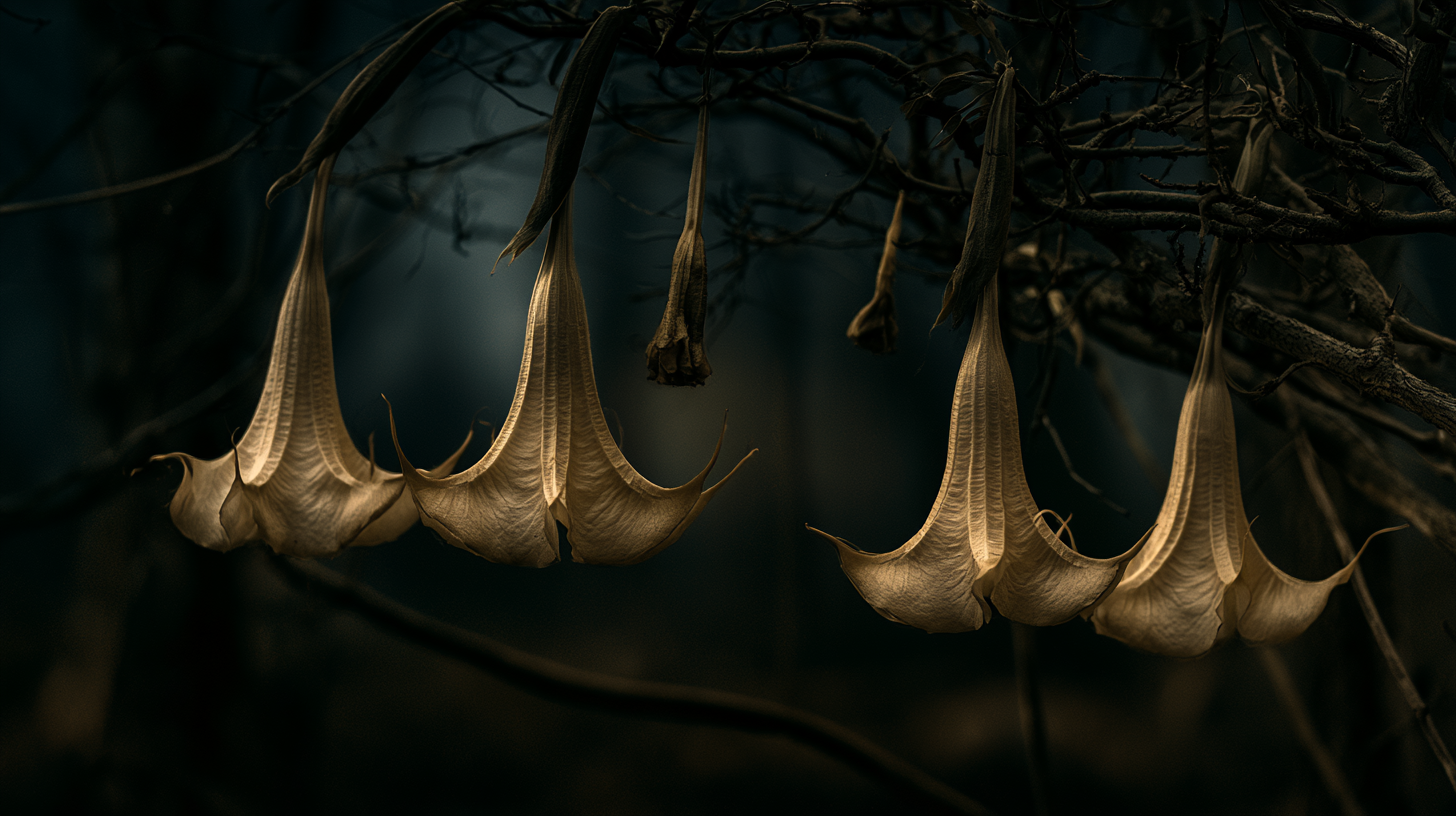
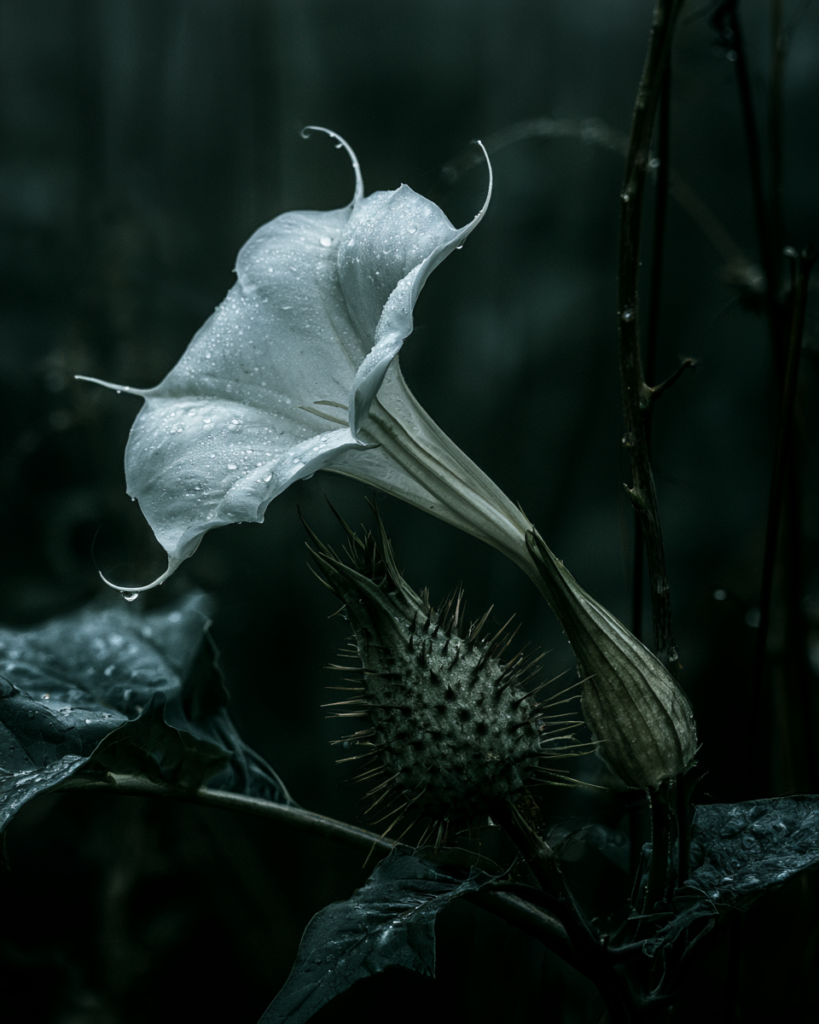
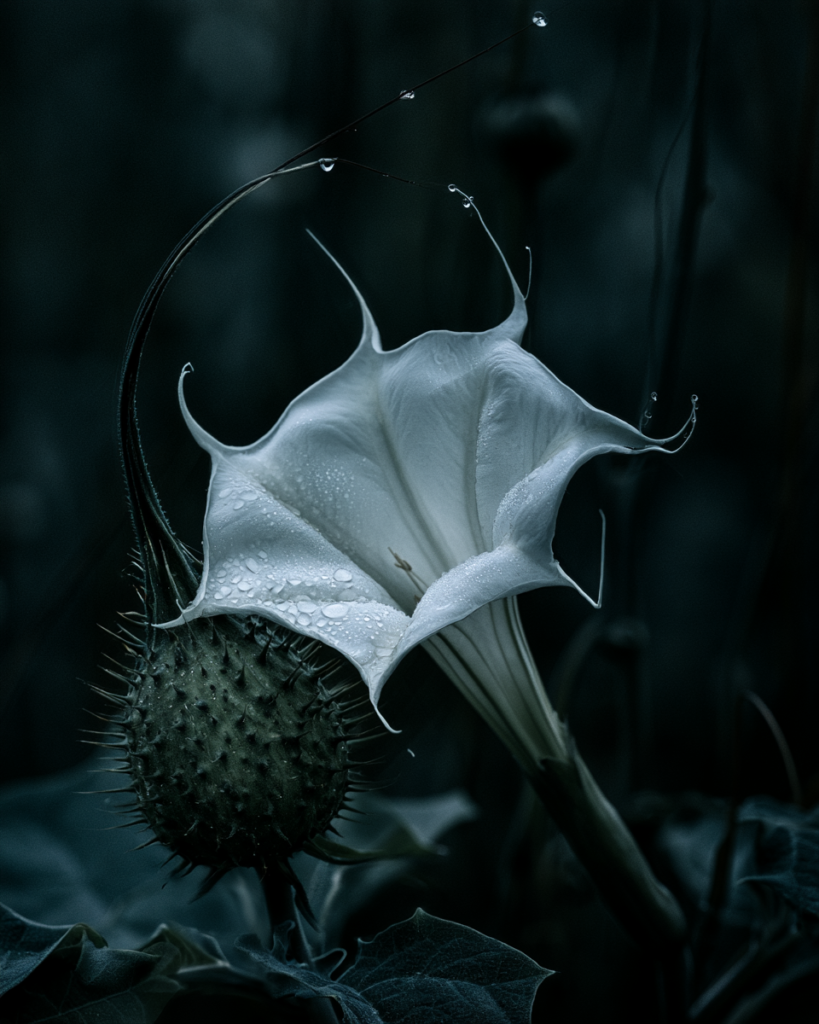
The flowers are the plant’s most recognizable feature: white or pale lavender, trumpet-shaped, up to 10 centimetres long, and held upright on the plant. They open in the evening and typically last only a single night before closing.
The seed pods that follow are covered in short spines, which is where the common name thorn apple comes from. As the pods ripen and split open, they release numerous small black seeds, the most concentrated source of alkaloids in the plant and the part most often responsible for accidental poisonings.
Datura grows readily in disturbed soil: roadsides, vacant lots, and the edges of cultivated fields. It tends to appear wherever ground has been recently turned over, which is part of why it shows up so often at the margins of human activity rather than in undisturbed wild spaces.
RELATED:
The Poison: What It Does
Like other members of the Solanaceae family, datura contains tropane alkaloids, primarily atropine, scopolamine, and hyoscyamine. These compounds block a neurotransmitter called acetylcholine, producing what toxicologists call anticholinergic syndrome.
What sets datura apart is how unpredictable its alkaloid concentration is. Levels vary between individual plants, between different parts of the same plant, and even between seeds from the same pod, depending on factors like soil, growing conditions, and the plant’s age.
Because of this, there is no reliable way to estimate a safe dose from the outside. The same quantity of plant material can produce very different effects in different people, or in the same plant grown a season apart.
Anticholinergic poisoning from datura typically involves:
- Dry mouth, throat, and skin
- Significant pupil dilation and blurred vision
- Rapid heart rate
- Elevated body temperature
- Confusion and disorientation
- Vivid hallucinations
- Agitation
- Memory loss for the period of intoxication
- In severe cases, seizures, respiratory depression, and death
Datura-induced hallucinations are often described as distinct from those caused by other psychoactive substances. Rather than being experienced as clearly separate from reality, they are frequently described as indistinguishable from it: people report interacting with others who are not present or perceiving objects and animals that do not exist, without any sense that something is wrong.
Because of this unpredictability, medical literature consistently treats datura exposure as a situation requiring prompt medical attention, not something to be self-managed.
History and Folklore
Datura has a documented presence in ceremonial and medicinal traditions on more than one continent, independently arrived at by cultures with no contact with one another.
Among some Indigenous peoples of California, including the Chumash and Luiseño, a related species, Datura wrightii, was used in supervised initiation ceremonies, prepared and administered by people with specialized knowledge of dosing. Even within these traditions, the plant was treated as inherently risky rather than routine.
In parts of South Asia, datura has long associations with religious practice, including its appearance in devotional imagery connected to Shiva, though it was generally offered rather than consumed by worshippers. The plant was also historically used by the Thuggee, a criminal network operating in India through the early nineteenth century, who added datura to food to incapacitate travelers before robbing them.
In Europe, datura appears alongside belladonna and henbane in historical accounts of so-called flying ointments associated with witchcraft. Its documented ability to be absorbed through the skin lends some plausibility to how such preparations may have produced altered states in the people who used them.
One of the better-documented poisoning events in early American history took place in Jamestown, Virginia, in 1676, when soldiers unknowingly ate datura leaves cooked as greens. According to the surviving account, the men experienced roughly eleven days of disorientation before recovering. Not every historical account of datura ingestion ends the same way; the Jamestown case is notable partly because it was well recorded and because the outcome was survivable.
Datura has also appeared in more conventional medicine over the centuries, including as a smoked treatment for asthma in the nineteenth century and in some traditional surgical preparations, though these uses have long since been replaced by safer, more precisely dosed alternatives.
In the Poison Garden
Datura earns a place in a poison garden collection for the same reason it recurs throughout history: the distance between its beauty and its danger is unusually short, and that contrast is central to what a poison garden is meant to illustrate.
Its flowers are genuinely ornamental, and it is not a rare or exotic plant. It grows unassisted in disturbed ground in many parts of the world, often close to where people live.
As a subject for illustration, datura offers two distinct forms worth featuring: the large trumpet flower, and the spined seed pod, which is less commonly depicted but equally distinctive. Both suit a Victorian-style botanical illustration approach, rendered either in fine-line detail or in a more atmospheric style.
A Note on Safety
Datura stramonium should never be ingested, smoked, or otherwise consumed. Alkaloid concentration varies unpredictably between plants and even between parts of the same plant, which means there is no dose that can be considered reliably safe.
If datura poisoning is suspected, seek emergency medical attention immediately. Symptom onset can be rapid, and the disorientation involved can make it difficult for an affected person to recognize that something is wrong or to seek help on their own.